Singapore Orders Caracal and CH-47F Helicopters

3:30:00 PM Add Comment
SINGAPORE, -- MINDEF Signs Contracts to Acquire New medium-and Heavy-Lift Helicopters The Singapore Ministry of Defence has awarded a contract to Airbus Helicopters for the acquisition of the H225M - Medium Lift Helicopter and a contract to The Boeing Company for the acquisition of CH-47F - Heavy Lift Helicopter.

The new H225M and CH-47F will replace the Republic of Singapore Air Force (RSAF) 's existing Super Pumas and older Chinooks, the which have been in service since 1983 and 1994 respectively, and are facing Obsolescence.

CH-47F Chinook (photo: Glenn Anderson) The H225M and CH-47F possess better lift and reach capabilities, and will enable the RSAF to meet the Singapore Armed Forces (SAF) 's lift requirements more efficiently with fewer helicopters and less manpower.

The acquisition of the H225M and CH-47F will Ensure that the RSAF continues to Effectively meet the SAF's lift requirements for a wide spectrum of operations, Including Search and Rescue (SAR), Aeromedical Evacuation (AME) and Humanitarian Assistance and Disaster Relief (HADR ) operations. The replacement aircraft were selected after a rigorous evaluation process.


The Airbus Helicopters H225M Caracal Tactical Transport Helicopter.


The U.S. Army-CH-47F tandem rotor Heavy-lift Transport Helicopter.


https://goo.gl/JCuoNp


PT DI ready to deliver two NC212i aircraft ordered by Philippines next year

7:10:00 PM Add Comment
MANILA, -- State-owned aircraft manufacturer PT Dirgantara Indonesia (DI) says it has completed the manufacturing of two NC212i aircraft ordered by the Philippines.

Equipped with ramp doors and a modern navigation and communication system, the multipurpose plane, which is the latest generation of NC212 and has a carrying capacity of 28 passengers, is the first Indonesian aircraft ordered by the Philippines. The Philippines has not upgraded its air force’s fleet its aircraft in the last 20 years.

PT DI commerce and restructuring director Budiman Saleh said the purchasing contract of the two NC212i aircraft, including their spare parts, was worth US$19 million.

“We can do it in affordable prices, and with no dependency to the US. You can also put Israeli technology inside,” Budiman said. He accompanied Raymundo de Vera Elefante, Undersecretary for Finance, Ammunitions, Installations and Materials of the Department of National Defense, and Philippine Air Force Chief of Air Staff Maj.Gen. Rozzano D Briguez during a visit to the company’s fixed wing airplane hangar in Bandung on Friday.

Budiman further said the delivery of the aircraft would be conducted after Philippine pilots received training about the instruments and technical conditions at PT DI.

“We will take it on time. Hopefully, it will arrive in the Philippines in the first semester [of next year]. Our pilots will receive training this December,” said Elefante.

According to PT DI, the NC212i aircraft can be used for producing artificial rain, maritime patrol and coast guard patrol. More than 600 units of its previous generation C212 series have been used by 38 countries, including Chile, Mexico, South Africa, Spain, Thailand, the Philippines and the United Arab Emirates.


Philippine Air Force Chief of Air Staff Maj.Gen. Rozzano D Briguez (right) and Raymundo de Vera Elefante (center), Undersecretary for Finance, Ammunitions, Installations and Materials of the Department of National Defense, listen to state-owned aircraft manufacturer PT Dirgantara Indonesia (DI) commerce and restructuring director Budiman Saleh (left) in a visit in Bandung on Nov.4.


https://goo.gl/JsCde5


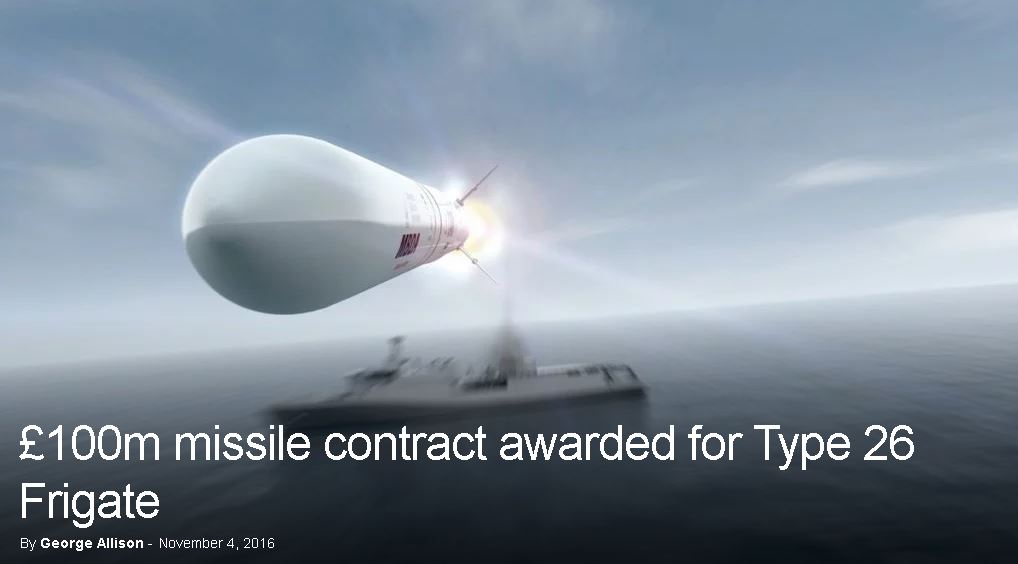
£100m missile contract awarded for Type 26 Frigate

9:47:00 PM Add Comment


The Ministry of Defence has awarded a £100m contract to deliver the Sea Ceptor air defence missile system for the new Type 26 Frigate.

The new ‘Demonstration and Manufacture’ phase contract will support additional design work and allow equipment to be manufactured to equip the entire Type 26 fleet.

According to a press release, the work will sustain around 85 jobs, including 55 at MBDA’s sites in Bristol, Stevenage and Lostock and 30 across the UK supply chain.

Companies on the supply chain include Babcock in Leicester, Churrock Engineering in Chelmsford, Quadrant in Todmorden, API in Milton Keynes, Meggitt in Stevenage and Aish in Poole.

Defence Secretary Michael Fallon has also confirmed the Type 26 Frigate order on the Clyde and revealed that steel will be cut in Summer. Work on building eight Type 26 frigates at Clyde shipyards will begin the summer of 2017, the defence secretary has announced.

Michael Fallon said the date for cutting the first steel would help secure new investment and safeguard hundreds of skilled jobs until 2035.

The missile system has already been selected by the Royal New Zealand Navy for use on board their Anzac class frigates, with considerable potential for additional overseas orders in the future.

Minister for Defence Procurement Harriett Baldwin said:

“Sea Ceptor will ensure the Royal Navy’s Type 26 Global Combat Ships are protected as they, in turn, protect the UK and her interests, keeping our nuclear deterrent submarines and the UK’s two new Queen Elizabeth Class aircraft carriers safe on operations around the globe.

Supported by our rising Defence budget and our £178 billion equipment fund, Sea Ceptor is yet another example of how the MOD investing in cutting-edge kit to help our Armed Forces meet future threats.”

Sea Ceptor is planned for use on board the Royal Navy’s current fleet of Type 23 frigates, which will eventually be replaced by Type 26, with three vessels currently being fitted with the system to allow sea trials throughout 2017.

The system offers significant improvements over previous air defence systems, such as Sea Wolf, with the ability to engage multiple targets more effectively at a longer range.

Chief Executive Officer for the MOD’s Defence Equipment and Support, Tony Douglas, said:

“Sea Ceptor is the future of air defence for the Royal Navy, and it is fantastic that Defence Equipment and Support and the MOD has led from the front in its development, working with industry to provide the UK’s Armed Forces with world-leading kit.”

Sea Ceptor is due to enter service on Type 26 in the mid-2020s, and on Type 23 in 2017.

By George Allison -  November 4, 2016

Source: here

Indonesian president's visit to Natuna Islands sends waters warning to China

9:37:00 PM Add Comment


Jakarta: Indonesian President Joko Widodo has held a cabinet meeting on a warship in the Natuna Islands in a defiant gesture to China that it has sovereign rights over the disputed waters in the far north of the archipelago.

Diplomatic tensions have been rising after three clashes between Chinese fishing vessels and the Indonesian navy in the region in as many months.

Indonesia is not a claimant in the territorial dispute in the South China Sea and China acknowledges that the Natuna Islands belong to Indonesia.

However part of the waters surrounding the islands, which are rich in marine life, fall within both Indonesia's exclusive economic zone and the so-called "nine-dash line" on which China bases its claim over most of the South China Sea.

China has strongly protested Indonesia's pursuit of its fishing vessels and demands Jakarta release apprehended crew members, saying they were operating in Chinese "traditional fishing grounds".

In the latest incident, China claimed a fisherman was injured when the Indonesian Navy apprehended one of 12 Chinese fishing vessels it said were operating illegally in the area over the weekend.

Mr Joko's press office released a statement on Thursday saying the development of the Natuna Islands was the government's main priority.

"In this working visit President Joko Widodo will lead a meeting on developing the economic potential of the Natuna Islands as one of Indonesia's foremost verandahs and national strategic areas," it said.

Mr Joko, who is only the third president to visit Natuna, was accompanied on Thursday by a number of high-powered ministers including Foreign Minister Retno Marsudi, Chief Security Minister Luhut Panjaitan and Maritime Affairs and Fisheries Minister Susi Pudjiastuti, who is famous for her tough stance on poaching, including the sinking of foreign trawlers.

Indonesia, which is keen to encourage foreign investment from China, has played down previous maritime spats with its powerful neighbour.

"I think it is a big deal," Evan Laksmana, from the Centre for Strategic and International Studies in Jakarta, said of Mr Joko's visit.

"Just because we are committed to maintaining a good relationship with China does not mean Indonesia is willing to sell out its waters. That is the delicate balance Jokowi is trying to tread - it needs to be made clear that the islands and waters surrounding the islands are ours."

Since the mid-1990s, Indonesia has played an "honest broker" role as a non-claimant in the South China Sea.

However Mr Laksmana said China needs to be prepared for Indonesia to be much more assertive if its sovereign rights continue to be tested.

An international tribunal convening in The Hague will soon hand down its decision in a landmark legal case that the Philippines has brought against China, including the legality of its nine-dash line claim.

"Both domestic and international pressure has been mounting for Indonesia to take a position with regard to the upcoming Permanent Court of Arbitration ruling," Mr Laksmana said.

Melda Kamil Ariadno, a professor of international law at the University of Indonesia, said she believed China was deliberately provoking Indonesia.

"Very soon the Permanent Court of Arbitration will issue a verdict and I believe it will cancel China's claim of a nine-dash line. That's why China is doing some manoeuvres."

Asked if the conflict would lead to deteriorating economic relations between the two countries, Dr Melda said: "Remember, it is not just us who needs China, but China needs us. So we do need to have a good relationship but it should not come at the price of sovereign rights and sovereignty."

Source: here

Why Japan Is Expanding Its Military in Africa

9:30:00 PM Add Comment


Sitting astride the Bab el-Mandeb Strait, which separates the Red Sea from the Indian Ocean and sees 30 percent of the world’s shipping traffic, Djibouti has become the center of geostrategic competition in Africa in recent years. China’s bid to build its first military base in the small desert nation made headlines late last year, especially due to the installation’s proximity to the biggest American facility on the African continent. Japan has also recently stepped into the fray: Tokyo has entered into negotiations with Djibouti’s government to expand its small military outpost there and to bring in C-130 transport aircraft, Bushmaster armored vehicles and extra personnel.

After Djibouti’s long-time President Ismail Omar Guelleh decided to kick out a secondary American outpost in the south of the country to make space for China’s future facility, Tokyo naturally grew concerned that its only African facility could face a similar fate. Japan realized that Guelleh’s increasingly erratic behavior could seriously imperil its national security, especially after the Djibouti strongman secured a fourth consecutive term in power in April by killing dozens of opposition figures, gagging journalists and torturing activists.

However, Japan’s surprise decision to expand its Djibouti base goes beyond guaranteeing its security interests. Instead, the move should be seen within the context of Tokyo’s growing desire to engage with the African continent and counterbalance China’s aggressive behavior in the South China Sea and elsewhere. The sixth Tokyo International Conference on African Development (TICAD), which brought together Japan and the African Union on August 27 and 28, was held in Africa for the first time and resulted in pledged investments in development projects worth a cool $30 billion - coming on top of $32 billion promised at the 2013 TICAD. These generous investments serve the long term goals Japan has set for Africa: with China’s economy slowing down and with many export-dependent countries feeling abandoned by Beijing - including Angola and South Africa - Tokyo is ready to fill the void.

In Asia, Japan’s parallel quest for allies has continued apace. China’s large-scale land reclamations in the South and East China Seas have burned bridges with many ASEAN countries. Mounting evidence of the artificial islands’ military purposes will accelerate that trend even more. As Thomas Shugart showed, Beijing is now able to strike targets in the Philippines and Singapore with land-attack ballistic missiles, cruise missiles and airpower from Fiery Cross, Subi and Mischief Reef. The Chinese military could also deploy an anti-access area-denial (A2/AD) system overnight. Mischief Reef’s land perimeter alone is the size of the District of Columbia, boasting sufficient space for mobile attack systems and a 10 thousand foot runway. This aggressive new posture has thoroughly undercut the mantra of “a peaceful rise.”

As such, Tokyo is looking to deepen its ties with those countries that share its unease with China’s resurgence. In September, the Japanese government announced it would deliver two new patrol ships to Vietnam after a previous delivery of ten patrol vessels to the Philippines. Additionally, and after tough negotiations, Japan and South Korea put to rest the issue of “comfort women” in a deal brokered with the help of the United States in December 2015. When the agreement was reached, President Obama praised all sides for demonstrating great “courage and vision to forge a lasting settlement to this difficult issue.” While some groups with ties to North Korea (like Chong Dae Hyup) are trying to force Seoul’s hand and undermine the agreement, Japanese prime minister Shinzo Abe and his South Korean counterpart Park Geun-hye, the daughter of South Korean general Park Chung-hee, have jointly managed to calm nationalist elements and secure what was widely heralded as a big diplomatic win.

The Japan-United States-Australia Trilateral Strategic Dialogue, constitutes another key partnership for Tokyo. At their most recent meeting in Washington this past July, the foreign ministers of the three countries united to express their opposition to China’s reclamation moves in the South China Sea.

While Japan has been energetic in organizing a united front, it would be a mistake to think China is quaking in its boots. Paradoxically, it is not Chinese machinations threatening Southeast Asia’s security balance so much as it is America’s wavering commitment to the region. In the United States, widespread opposition to the Trans-Pacific Partnership (TPP) has sent shivers down the spines of many Asian leaders. Singapore’s Prime Minister Lee Hsien Loong gave an impassioned defense of the trade deal, taking the example of Japan as an American ally whose trust in the American nuclear umbrella would be shaken if the trade deal does not pass.

Other ASEAN leaders have been more blunt. Rodrigo Duterte, the Philippines’ firebrand new president, is actively shifting his country away from Washington and pursuing a more accommodating foreign policy with China despite their ongoing South China Sea disputes. Similarly, Australia’s Malcolm Turnbull has kept an open door to Chinese interests and has leased the Darwin strategic port to a Chinese company closely associated with the military for 99 years. The Australian Strategic Policy Institute has warned that the Chinese could use the facility to spy on the more than one thousand U.S. Marines that deploy to the port every year. Even more disturbingly, Australia’s unexpected decision to award its largest ever-military contract (to build 12 submarines) to France is rumored to have been the result of Canberra’s deference to Beijing.

While Japan’s diplomatic forays in both Africa and Asia have helped band together a number of countries with shared interests, the specter of a diminished American presence in the Asia-Pacific threatens to deal a devastating blow to regional cohesion and stability. As China relentlessly pursues its land reclamation activities in the contested waters of the South China and East China Seas, Washington (and especially the next American president) would do well to remember just how much hinges on its security guarantees.

Rob Edens is a London-based researcher (currently working on ASEAN dynamics) and contributor to the Diplomat, the Straits Times, and EuObserver.

Image: A Japanese F-15J at Yokota Air Base. Wikimedia Commons/Creative Commons/@Morio

Source: here

PT PAL Signs MoU with Boustead to Build Malaysian Navy Ship in Indonesia

6:43:00 AM Add Comment
KUALA LUMPUR, -- Indonesian state-owned shipbuilder PT PAL has signed a memorandum of understanding (MOU) with Boustead Naval Shipyard (BNS) to construct Malaysia's first multirole support ship (MRSS) in Indonesia.

The MOU was signed on 2 November at the Indo Defence 2016 exhibition in Jakarta, and paves the way for PT PAL to work on its first-ever project for a Royal Malaysian Navy (RMN) vessel, if the contract is awarded to BNS.

Managing Director of BNS, Ahmad Ramli Moh Nor, who signed the MOU on behalf of the Malaysian company, described the agreement as a historic moment between the two countries, which were not known to have collaborated on any major naval platforms prior to the possible MRSS project.

According to specifications provided by PT PAL, its basic design for the landing platform dock (LPD)-like MRSS features an overall length of about 150 m, an overall beam of about 24 m, and a draught of 6 m. The platform has been designed with a top speed of about 18 kt, a cruising speed of about 15 kt, and an endurance of about 30 days.

The ship can be armed with a 76 mm naval gun, and a number of 12.7 mm machine gun positions.

However, an official from PT who spoke to IHS Jane's on 2 November at Indo Defence stressed that talks with the RMN and BNS are still ongoing, and a final configuration based on the service's requirements will only be available at a later date.

One of the RMN's requirements is that the ship must be able to accommodate two helicopters on the flight deck, in addition to two helicopters in the hangar, said PT PAL, who added that this may mean extending the platform's length to about 163 m.


The Royal Malaysian Navy future Multi-Role Support Ship (MRSS) will be made by PT PAL Persero Indonesia.


https://goo.gl/3cFPJj